Generator Sizing Guide — How Many kW Does a St. Louis Home Need?
Correct generator sizing comes down to adding up your home's starting and running watts, not guessing off square footage alone. Most St. Louis-area homes land in the 14-18 kW range for whole-house coverage, small homes running only essential circuits can get by on 7-10 kW, and large homes with two AC units or a pool pump often need 20-26 kW.
Generator sizing mistakes go two directions, and both are expensive in St. Louis County. An undersized unit trips the moment your central air compressor and well pump start at the same time — exactly the moment during a storm outage you need it most. An oversized unit means paying for capacity you'll never use and a bigger natural gas or propane line to feed it. A licensed contractor calculates your home's actual electrical load before quoting a size; this guide shows you the same math they use.
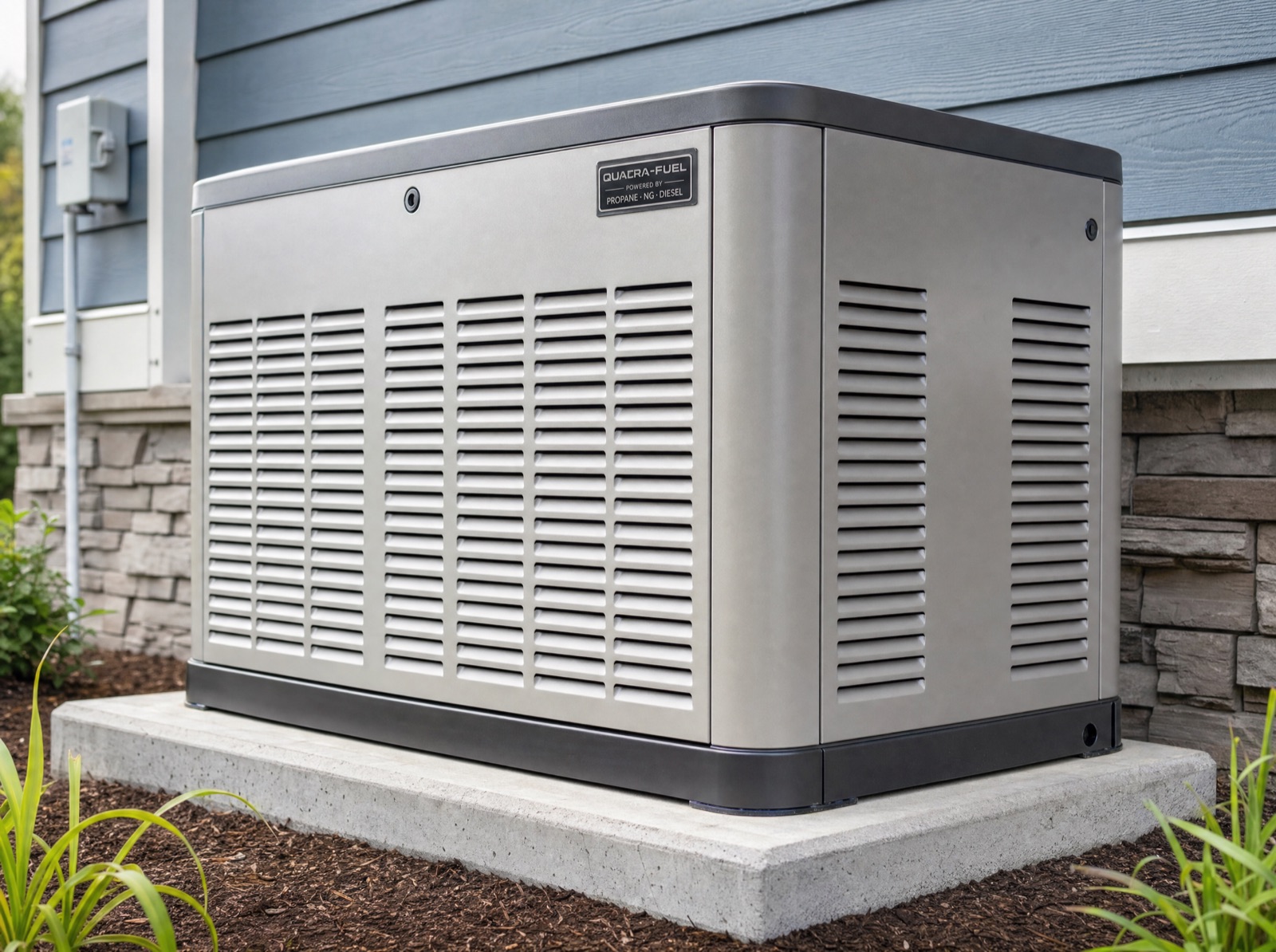
kW Sizing by Home Size
| Home Profile | Typical Load Covered | Recommended kW Range |
|---|---|---|
| Essentials only (any size home) | Fridge, sump pump, furnace blower, select outlets and lights | 7-10 kW |
| Under 2,500 sq ft, single AC unit | Everything above plus one central AC unit and kitchen circuits | 14-18 kW |
| 2,500-3,500 sq ft, single AC unit | Whole-house coverage including electric range or dryer | 18-22 kW |
| 3,500+ sq ft, two AC units or pool pump | Full whole-house load with simultaneous large-appliance draw | 20-26 kW |
Ranges reflect common residential load profiles; your panel's actual amperage and circuit list determine the final number a contractor quotes.
The Two Numbers That Matter: Running Watts vs. Starting Watts
A generator's nameplate kW is its continuous running capacity, but motors — AC compressors, well pumps, sump pumps — briefly draw 2-3x their running watts the instant they start. A 3-ton central AC unit runs at roughly 2,000-3,000 watts but can spike to 3,500-5,000 watts on startup. Sizing has to account for the worst-case moment several of those motors start close together, which is why a simple wattage add-up of "always-on" appliances alone tends to undersize the unit.
Add Up Running Watts
List every circuit you want powered during an outage and its continuous wattage draw.
Account for Starting Surge
Add the highest single starting-watt spike on top of your running total — that's your worst-case moment.
Round Up One Tier
Standby units are sold in fixed kW tiers; a contractor rounds up to the next available size, never down.
Run the Numbers on Your Own Home
Check off the circuits you want covered and our sizing worksheet totals the running and starting watts for you, then maps it to a recommended kW tier — no email required.
Use the Free Sizing Worksheet →Fuel choice affects the model you can buy more than the kW number itself — see our natural gas vs. propane comparison if your property doesn't have a gas line nearby. Once you have a target kW range, the Generac vs. Kohler cost guide shows what that size runs installed, and our cost calculator gives a fast budget range.
Codes & Standards
Final sizing and panel tie-in must comply with NFPA 70 (National Electrical Code) load-calculation rules, and the physical installation follows placement and clearance requirements under the ICC International Residential Code.
Generator Sizing FAQ
What size generator do I need for a typical St. Louis home?
Most St. Louis-area homes under 2,500 square feet run comfortably on a 14-18 kW standby unit, which covers central air, the furnace blower, well or sump pump, refrigerator, and general circuits at once. Homes over 3,500 square feet with two AC units or a pool pump often need 20-26 kW.
How many kW does it take to run central air conditioning during an outage?
A typical 3-ton residential central air unit draws roughly 3,500-5,000 starting watts and 2,000-3,000 running watts. That's usually the single largest load in a St. Louis home's sizing calculation, which is why undersized units trip the moment the AC compressor kicks on.
Does natural gas vs. propane change what size generator I need?
The kW rating you need is based on your home's electrical load, not the fuel source, but propane-fueled units are typically rated a few percent lower in continuous output than the same engine on natural gas, so a contractor sizing for propane may round up to the next model tier.
Do I need a professional load calculation or can I estimate myself?
A DIY estimate using our worksheet is a solid starting point for budgeting, but a licensed electrician still needs to confirm your panel's actual amperage and circuit list before ordering equipment — an estimate that's off by one size either wastes money or leaves you underpowered.